Never in Anger: Portrait of an Eskimo Family by Jean L. Briggs
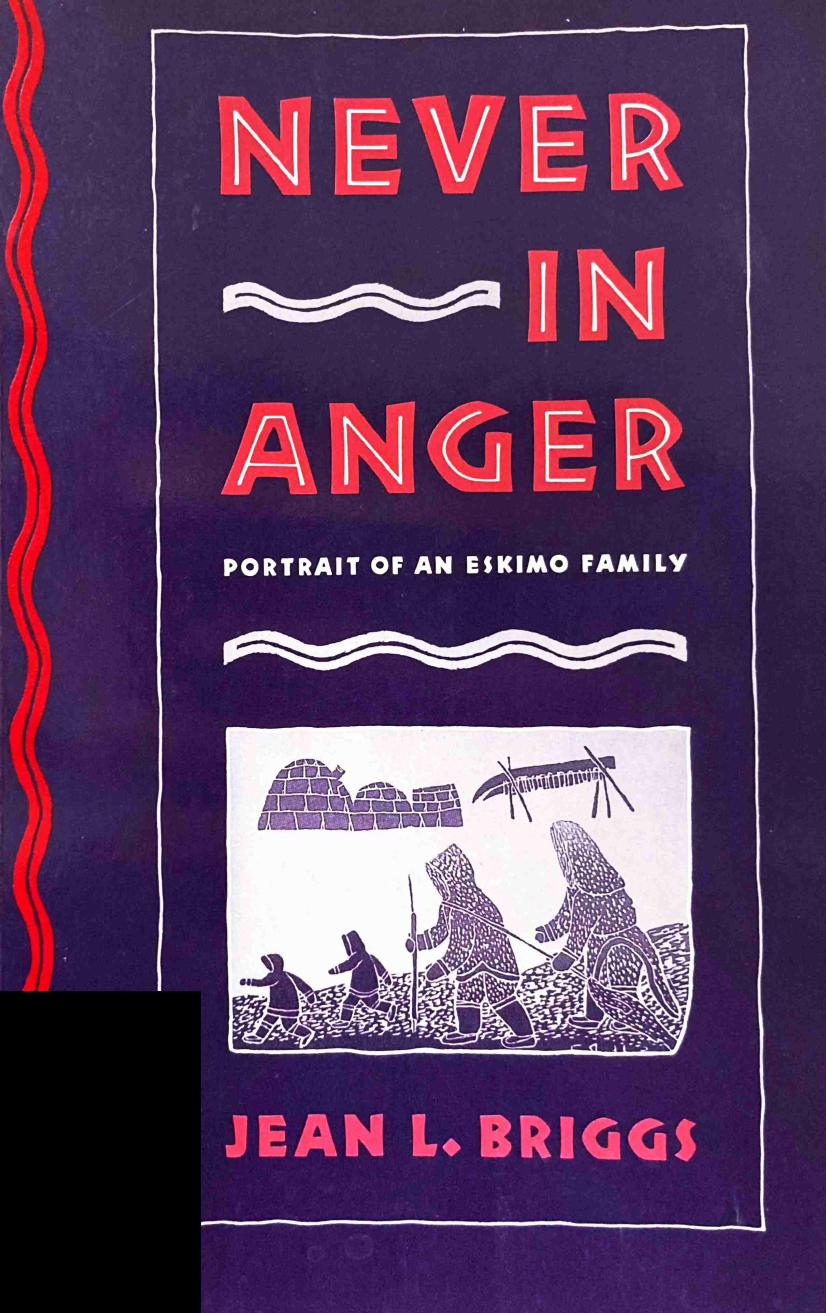
Author:Jean L. Briggs [Briggs, Jean L.]
Language: eng
Format: epub, pdf
Tags: Psychology, Developmental, Child, Social Science, Anthropology, Cultural & Social, Indigenous Studies
ISBN: 9780674608283
Google: A9QuJjQbh7MC
Publisher: Harvard UP
Published: 1970-01-15T22:39:45+00:00
* * *
1. A kin group, it will be remembered, consists of genealogical or adoptive siblings and the children of those siblings. See also section VI of the Introduction and Appendix III.
5
Nilakâs Family
During the months in which I lived as Inuttiaqâs daughter, the social world of my family was to a large extent my own world. Though for the sake of my work I made some effort to visit in other households more widely than my family did, the pattern of their associations could not help but influence mine: my visits were limited to the households that shared our camp, and I saw more of the people who visited frequently in our home than I did of others. Pala, with or without Ipuituq, was almost always with us, as was Piuvkaq until his death. Qavvik, on the other hand, almost never shared our spring, summer, or autumn camps; we saw him only in the winter, when all the households gathered in Amujat. Of the families who were not closely related to us, we were most in contact with Nilakâs.
It was a small family, Nilakâs, the smallest in the band. It consisted only of Nilak, his wife, Niqi, and their adopted daughter, Tiguaq, a girl of about seventeen; they had no children of their own. Nilak was the last remaining one of a group of brothers who used to camp together in Chantrey Inlet. Two of the brothers had died, and the third, crippled by tuberculosis, lived in Gjoa Haven, where life was not so rugged as it was in Chantrey Inlet. Niqiâs parents and siblings, too, had all either died or moved south to Baker Lake, so Nilakâs household was left without any close relatives at Back River. It was a lonely situation, and the loneliness was exacerbated by the personal peculiarities of Nilak and his wife. It was not that they camped far from other families, as I had been led to expect; they did not. Nilak was one of the âItimnaaqjuk-people,â those who habitually camped at Itimnaaqjuk, the Rapids, during the summer, as did Pala and the two associated households of Inuttiaq and Piuvkaq; but his isolation was all the more visible for that very reason. It was especially visible to me the autumn I first arrived in Chantrey Inlet, when his tent stood alone on the far shore of the river, facing, across the rapids, the clustered tents of the other families a quarter of a mile away. The howling of his dogs came to us on the breeze, and we watched the household like puppets coming and going about their toy tent, gathering their fuel, fishing, and setting their nets on their own side of the river. Within sight, as they were, and yet out of the range of immediate neighborly contact with the other tents, they seemed more distant than if they had been miles away.
My first meeting with Nilakâs family occurred just a week after I joined the two elderly brothers, Pala and Piuvkaq, at the Rapids.
Download
Never in Anger: Portrait of an Eskimo Family by Jean L. Briggs.pdf
This site does not store any files on its server. We only index and link to content provided by other sites. Please contact the content providers to delete copyright contents if any and email us, we'll remove relevant links or contents immediately.
Spare by Prince Harry The Duke of Sussex(5181)
Machine Learning at Scale with H2O by Gregory Keys | David Whiting(4296)
Fairy Tale by Stephen King(3370)
Will by Will Smith(2911)
The Bullet Journal Method by Ryder Carroll(2561)
Hooked: A Dark, Contemporary Romance (Never After Series) by Emily McIntire(2551)
Rationality by Steven Pinker(2352)
It Starts With Us (It Ends with Us #2) by Colleen Hoover(2345)
Can't Hurt Me: Master Your Mind and Defy the Odds - Clean Edition by David Goggins(2324)
Friends, Lovers, and the Big Terrible Thing by Matthew Perry(2219)
The Becoming by Nora Roberts(2189)
Love on the Brain by Ali Hazelwood(2062)
A Short History of War by Jeremy Black(1843)
The Strength In Our Scars by Bianca Sparacino(1841)
HBR's 10 Must Reads 2022 by Harvard Business Review(1840)
Leviathan Falls (The Expanse Book 9) by James S. A. Corey(1729)
A Game of Thrones (The Illustrated Edition) by George R. R. Martin(1726)
515945210 by Unknown(1662)
Bewilderment by Richard Powers(1609)
